After the Lockout: The Verification Steps That Decide Whether the Procedure Worked
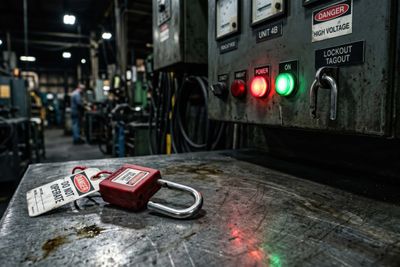
Most failures in lockout/tagout procedures are not where reliability teams expect to find them. The dangerous moment is not the application of energy isolation. It's the return to service.
This is the half of the procedure that gets less attention in training, less rigour in execution, and almost no scrutiny in audits. The lockbox came off. The work was completed. The line was restarted. As far as most paperwork is concerned, the procedure worked. The trouble is that paperwork rarely captures what happened in the last few minutes.
OSHA 1910.147 has been a top-10 most-cited standard for more than a decade [1]. The citations are useful as a leading indicator but they understate the issue. Most return-to-service failures never become citations. They become near-misses, unplanned downtime, equipment damage, and the occasional incident report that reads “stored energy unaccounted for.” Reliability engineers tend to see the consequences in availability data weeks after the fact, with no obvious link back to the procedure that caused them.
A few patterns turn up repeatedly.
Take a multi-discipline job involving electrical, mechanical and instrumentation work. Several authorised employees apply their own locks. Each person verifies their own work as they remove their lock. No one is accountable for verifying the whole. The mechanical team confirmed their valves are back open. The electrical team confirmed their breakers are racked in. Nobody confirmed both, and certainly not in the right sequence. The first person to start the equipment finds out what was missed.
Or take the procedure that begins on day shift and ends on night shift. The applying employees are not the removing employees, but the pre-removal checklist treats this as administratively equivalent. It is not. The night shift inherits an isolation they did not apply, with verification steps that depend on knowledge they did not gain. Most procedures handle this by making the night shift re-verify, which in practice means walking the same path with less context.
Then there's the post-LOTO check that has quietly become a ritual. The list exists. It's filled in. It's signed. It's identical to last week's, and the week before, because every step gets a tick regardless of what was actually checked. Field staff develop a reasonable suspicion that the form is for the file, not for the work. The form gets defended. The work gets degraded.
So what does good return-to-service look like in practice?
First, a single named role accountable for confirming that every isolation point applied at the start of the procedure has been physically restored to its operational state, in the right order, before any energy is reintroduced. This is not the same as confirming locks are removed. Locks come off when the work is done. Operational verification confirms valves are in the correct position, breakers are racked in correctly, dampers are reset, and any temporary jumpers or bypasses are removed.
Second, a sequenced re-energisation plan. Most equipment has an order in which energy sources should return, typically lowest-stored-energy first and sequentially up from there. A procedure that lists isolation points without sequencing them is a procedure that has not finished thinking through the work. The information usually exists in the engineering documentation. It rarely makes it onto the field-facing checklist.
And third, verification evidence that survives the moment. Whatever your post-execution checklist looks like, it should produce a record that an auditor, or you, six months later, after an unplanned trip, can use to reconstruct what was actually checked, by whom, at what time. A signed paper form with 12 identical ticks is not evidence. A timestamped sequence of confirmations from the people who did the checks, even handwritten in a logbook, is.
There's nothing novel here. It's what 1910.147 already implies. What's missing on most sites is the operational discipline to treat the second half of the procedure with the same care as the first. Application of energy isolation is the part that gets the training time. Restoration of energy is where the avoidable incidents tend to happen.
For reliability engineers, the practical question is whether your post-LOTO data tells you anything. Near-miss reports clustering at restart, unplanned trips correlating with completed work orders, post-execution checklists at 100% compliance while incidents continue: any of those is a return-to-service problem you are not measuring.
The procedure isn't over when the lockbox comes off. It's over when the equipment is producing again, the way it was producing before, with no surprises.
Sources
[1] U.S. Department of Labor, Occupational Safety and Health Administration. Top 10 Most Frequently Cited Standards. https://www.osha.gov/top10citedstandards