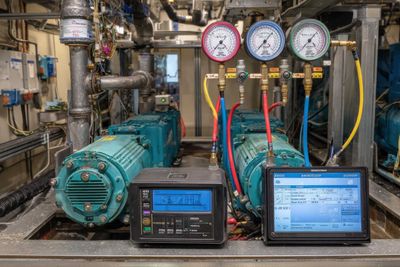
One of the more interesting cases I discovered while visiting a customer was how Operator Rounds is being used in an older plant environment.
During my recent visit to a large plant in South Texas, I observed something remarkable: it felt like they were giving new life to an aging facility with a modern digital solution—without making a massive capital investment.
The plant was built roughly 70 to 80 years ago, and much of the equipment is still quite old. While some critical assets have advanced sensor systems installed, a significant portion of the equipment has little to no digital monitoring. Much of it still relies on local analog gauges and manual meter readings, with no direct sensor integration or Distributed Control System (DCS) connectivity.
And yet, the plant has found a practical way to bridge the gap between what is measured digitally and what is not.
A Common Challenge in Aging Plants
This is likely not a unique scenario. Many plants around the world operate with a mix of:
- Old and new equipment,
- Digitally connected and non-connected assets,
- Automated measurements and manual field readings.
In these environments, some systems are fully integrated with sensors and the DCS, making them easy to monitor in real time. At the same time, many other areas of the plant remain only partially connected—or not connected at all.
That gap creates a real operational challenge: how do you gather reliable field data efficiently without fully modernizing every asset?
How This Plant Uses Operator Rounds
This plant has done something particularly effective with its Operator Rounds solution.
Like in many facilities, operators perform rounds two to three times a day. During these rounds, they collect readings from field equipment. What makes this implementation notable is that the rounds include a combination of:
- Manual readings from analog gauges and legacy meters, and
- Readings from equipment that is already measured by the DCS.
At first glance, it may seem unnecessary for operators to capture values that are already available in the control system. But that is exactly where the value lies.
Once the operator-entered readings are synced to the APM (Asset Performance Management) server, the system compares them with the corresponding values coming from the DCS. Because the Operator Rounds solution captures not only the reading, but also the timestamp and the identity of the operator who recorded it, the plant can compare field observations against system measurements with a high level of traceability.
Turning Manual Rounds into a Validation Layer
Using the operator’s exact timestamp and the corresponding DCS value from the same time window, the plant has effectively created a simple but powerful validation mechanism.
If there is a significant deviation between:
- The value recorded by the operator in the field, and
- The value reported by the sensor through the DCS,
the system flags the discrepancy for further review.
This does not directly solve the issue for equipment that has no DCS connectivity, but it creates a very useful benchmark. It helps the plant understand variance between field-observed values and control-system values wherever both exist. When that variance exceeds an acceptable threshold, an alert can prompt the lead operator or supervisor to investigate.
That investigation may reveal several things:
- The field reading was entered incorrectly.
- The operator misread the gauge.
- The gauge itself is drifting or failing,
- The sensor or control-system reading is inaccurate,
- (Or) The asset may require calibration, maintenance, or replacement.
In other words, the rounds process is not just for data collection—it becomes a tool for data validation, asset reliability, and operational discipline.
Benefits Beyond the Data
What stood out to me is that this approach delivers value in several ways, especially in older plants or facilities with mixed levels of automation.
1. It improves confidence in field data
Because manual readings are periodically cross-checked against DCS values, the plant can verify whether operators are taking readings accurately and consistently.
2. It strengthens operator accountability
Since the system captures the operator name and timestamp, it becomes easier to confirm that rounds are actually being completed in the field, at the expected times, and with the required level of precision.
3. It helps identify bad instruments
If a meter or gauge repeatedly shows values that deviate beyond an acceptable range, it may indicate that the instrument needs maintenance, recalibration, or replacement.
4. It avoids unnecessary automation costs
Not every subsystem in an older plant can be economically upgraded with sensors and connectivity. This approach allows the plant to improve visibility and reliability without needing to automate everything at once.
5. It creates a hybrid operating model
By combining sensor-based monitoring with operator rounds, the plant has built a practical ecosystem where people and technology complement each other. That hybrid model helps maintain reliability while keeping risk under control.
A Practical Example
Imagine a legacy pump system with a local pressure gauge that an operator reads manually during rounds. Nearby, a newer part of the system may already be connected to the DCS and reporting pressure digitally.
If the operator consistently records a pressure value that differs significantly from the DCS trend under similar conditions, the plant can investigate whether:
- The manual gauge is out of calibration
- The digital sensor is drifting
- The operator needs additional training
- (or) The process conditions are changing faster than expected.
Over time, this comparison becomes a low-cost way to improve both instrument health and data quality.
Operational Value
In many industrial facilities, especially older ones, digital transformation does not happen at once. It happens in layers.
Some assets get modernized, while others remain manual. Some systems are instrumented deeply, while others are monitored through operator expertise and field observation.
What this South Texas plant demonstrated is that modernization does not always require replacing everything. Sometimes, the smarter approach is to build a system that connects the old and the new in a way that is operationally useful.
That is exactly what this Operator Rounds implementation achieves.
Final Thought
While meters and gauges are the examples in this case, the same logic can be applied much more broadly.
Any environment with a mix of manual observations and automated measurements can benefit from this model. Whether it is temperature checks, vibration observations, tank levels, valve positions, or other field parameters, combining operator rounds with system-based validation can create a more reliable and cost-effective operating strategy.
For plants that are not ready—or not able—to fully digitize every asset, this may be one of the most practical ways to move forward.