In high-volume logistics operations, failures rarely start as emergencies. A sorter drive that seizes at 2 a.m., a control cabinet that trips mid-shift, a conveyor that grinds to a halt during peak: none of these begin at the moment they happen. They start days or hours earlier, as small, detectable signals that nobody was watching for.
That gap, the time between when a signal first appears and when a team actually finds out, is what a new reliability approach calls detection latency. In conveyorized, automation-heavy environments, it's an expensive gap to leave open: downtime in distribution and sortation environments can run $10,000 to $50,000 per hour, plus another $15 to $50 per affected shipment once SLA cutoffs are missed — before recirculation labor and recovery work are even counted.
That framing is the starting point of a new whitepaper, "The Detection Latency Problem: A Reliability Maturity Blueprint for High-Volume Logistics Operations," which lays out a practical model for closing that gap across sorters, conveyors, drives, and electrical systems.
Where Failures Actually Begin
The blueprint's core argument is that failures in conveyorized logistics almost never start as stops. They start as degradation: a bearing running slightly warmer as lubrication breaks down, a VFD enclosure trending hotter as a cooling fan loses efficiency, a belt drifting off-center as idler conditions shift. Each of these signals can exist for hours, sometimes days, before anything escalates into an operational event. The equipment is still running. The alarms are still quiet. In most facilities, there's no system designed to see what's developing until it's already failed.
Four Tiers, One Central Question
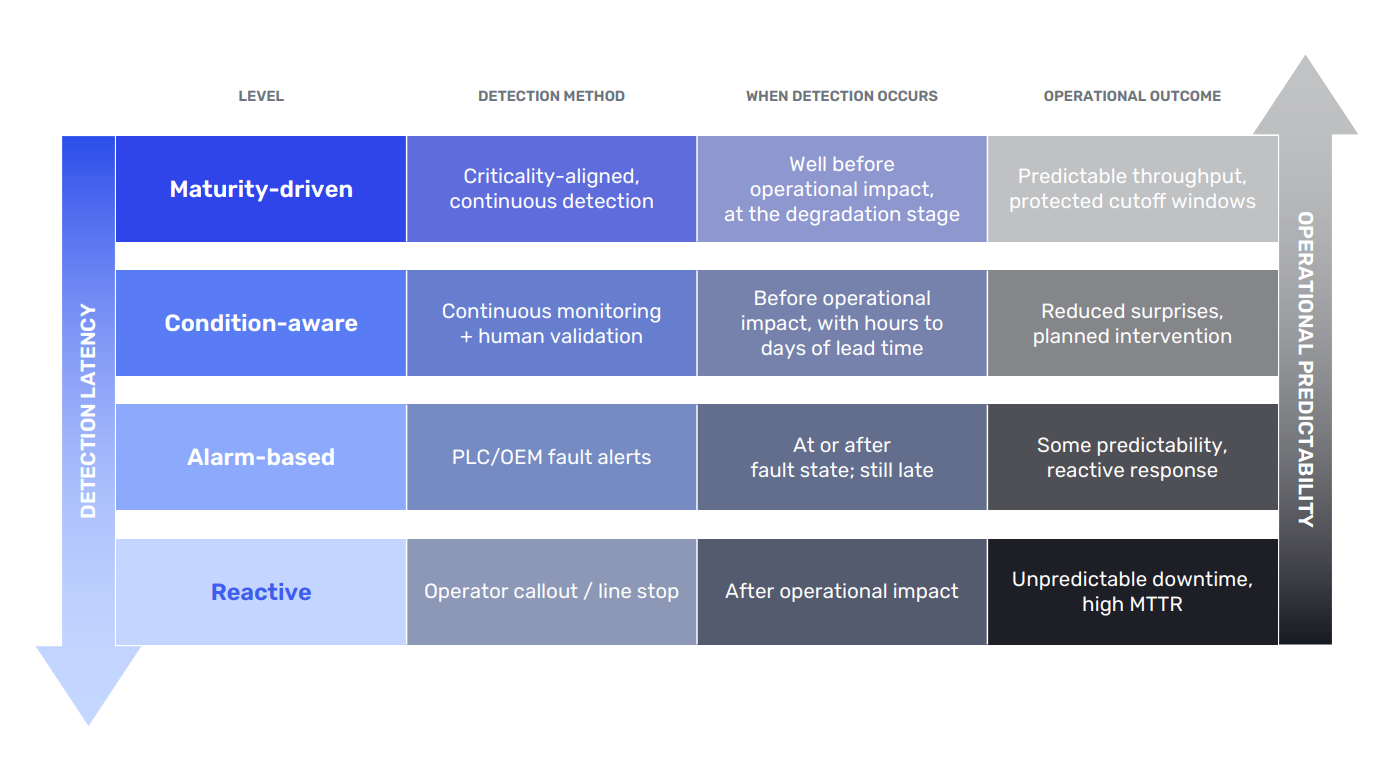
The blueprint's four tiers of detection maturity, and how the gap between them tracks detection latency and operational predictability.
Rather than treating reliability maturity as a matter of technology sophistication, the blueprint organizes it around a single question: when do you find out? It maps four tiers of detection maturity, reactive, alarm-based, condition-aware, and continuous condition intelligence — and shows how the gap between them widens or narrows depending on how deliberately an operation has matched its detection strategy to what each asset is actually worth protecting.
Most organizations, the whitepaper notes, discover they're operating one tier below where they believed they sat, and the gap tends to be widest on the exact assets that can least afford a missed signal.
The Physics Behind the Model
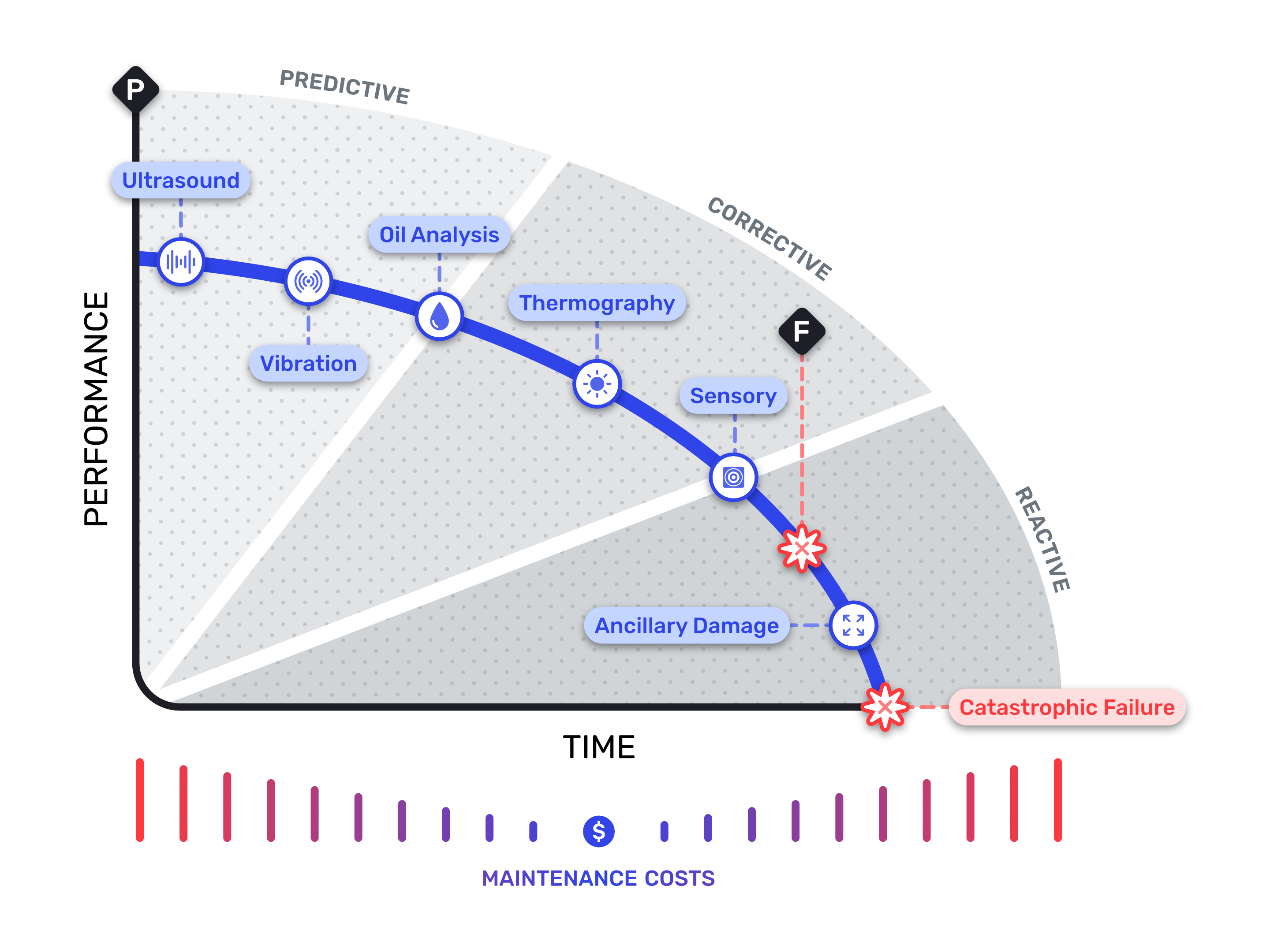
The P-F curve maps the window between the earliest detectable sign of degradation and functional failure, and where different detection methods fall along it.
Underneath the maturity model is the P-F curve, a foundational concept in reliability engineering that describes the interval between the earliest detectable sign of degradation (Point P) and the point of functional failure (Point F). That interval is the window where intervention is still possible without operational impact. The blueprint walks through how thermal, mechanical, and electrical degradation each follow different trajectories, and why periodic inspection routes measured in weeks structurally cannot keep pace with failure modes that develop in hours or days.
Where the Blast Radius Is Widest
Not every asset carries the same risk. The blueprint identifies five asset classes where the combination of failure frequency and operational consequence is highest:
- High-speed sorter drives
- MCC and VFD cabinets
- Conveyor trunks and merge clusters
- Induction and singulation systems
- Control cabinets and electrical panels
For each, it maps the dominant failure modes, typical detection windows, and where current practice tends to fall short, along with the maturity gap opportunity specific to that asset class.
Turning the Blueprint Into a Financial Case
Rather than leaning on someone else's deployment numbers, the blueprint's financial model is built to be rebuilt with a facility's own data. It walks through three value drivers, avoided downtime, labor reallocation, and escalation avoidance, each anchored to a conservative, clearly stated assumption, so operators can substitute their own downtime history and labor costs to produce a site-accurate figure rather than borrowing a benchmark that may not reflect their own environment.
A Roadmap Built Around Evidence, Not Everything at Once
The blueprint closes with a six-step implementation roadmap:
- Establish a detection-maturity baseline
- Run an asset criticality assessment
- Align strategy to tier
- Deploy on Tier 1 assets first
- Define alert governance before scaling
- Expand based on measured outcomes
The throughline across all six steps is deliberate sequencing. The goal isn't to monitor everything at once; it's to detect what matters early enough to act, prove it, and then expand.
Where to Go From Here
The full blueprint includes the complete Reliability Maturity Model, the asset-level detection gap analysis, the financial approach with worked assumptions, and the six-step roadmap in detail. For readers who want the numbers behind the maturity gap itself, a companion piece breaking down the cost of detection latency by industry is available here.
If you want to see a deep dive into the blueprint, join the upcoming webinar on September 15th, which will walk through the detection latency problem in more detail, including a look at how to benchmark your own operation's detection maturity.