AI creates insight. Enterprise Asset Management converts that insight into controlled work, accountable decisions and measurable operational value.
By Rajiv Kumar Mishra, Pravir Kumar and Shashwat Gawshinde
Utilities are under pressure to deliver safe, reliable, affordable and lower-carbon services while managing ageing networks, capital programmes, workforce constraints, cyber exposure and increasingly complex operating conditions.
AI can help utilities detect weak signals, predict failure risk, prioritize interventions and improve planning. But a prediction does not create value by itself. Value appears only when the insight reaches an accountable operational decision, becomes safe and executable work, and produces an outcome that can be measured.
This is where Enterprise Asset Management becomes critical. EAM connects asset identity, maintenance strategy, work planning, materials, field execution, cost and asset history. In an AI-enabled utility, it becomes the execution backbone that converts intelligence into controlled action.
The real advantage does not come from producing more predictions. It comes from turning trusted intelligence into consistent operational action.
Why Utility Operations Must Evolve
Traditional utility operations depend on expert interpretation of alarms, periodic inspection, fixed maintenance schedules and coordination across multiple systems. That experience remains essential, but it can be too slow for environments producing large volumes of signals across remote and ageing assets.
Five forces are reshaping the operating model:
- Reliability pressure: constrained networks and critical assets require faster, risk-based intervention.
- Ageing infrastructure: higher failure probability increases maintenance and renewal demand.
- Energy transition: distributed resources, storage and variable generation increase operational complexity.
- Workforce transition: scarce technical knowledge must be made easier to access and apply.
- Cyber and regulatory expectations: connected operations require stronger control, traceability and resilience.
The shift should happen in stages: from visibility to prediction, from prediction to coordinated workflows and, only where justified, to bounded autonomous action.
EAM Is the Execution Backbone
Enterprise Asset Management is more than a work-order system. It is the operational system of record that links asset strategy to planned, scheduled, executed and auditable work.
For utilities, the EAM foundation should connect:
- Asset identity, hierarchy, location, condition and criticality
- Maintenance strategies, job plans, permits and safety requirements
- Labor, contractors, skills, materials and critical spares
- Field execution, failure coding, closeout evidence and cost history
- Asset performance, repeat failure, lifecycle risk and investment decisions
AI predicts and recommends. EAM converts those recommendations into controlled work, accountable decisions and reusable asset history.
Design the Decision Loop, Not Just the Model
A utility use case creates value only when insight reaches execution and the result is captured for learning. The recommended design is a closed decision loop with clear ownership at every hand-off.
- Sense: collect condition signals, alarms, inspections, weather, loading and work history.
- Contextualize: resolve the asset, location, hierarchy, operating state, criticality and maintenance strategy.
- Assess: estimate condition, probability of failure, consequence, urgency and confidence.
- Decide: compare monitor, inspect, maintain, refurbish, replace or operate differently.
- Authorize: apply risk-based approval, safety review, budget control and segregation of duties.
- Execute in EAM: create or update work, job plans, permits, materials, crews and schedules.
- Learn: capture findings, failure codes, labor, parts, condition and outcomes to improve strategies and models.
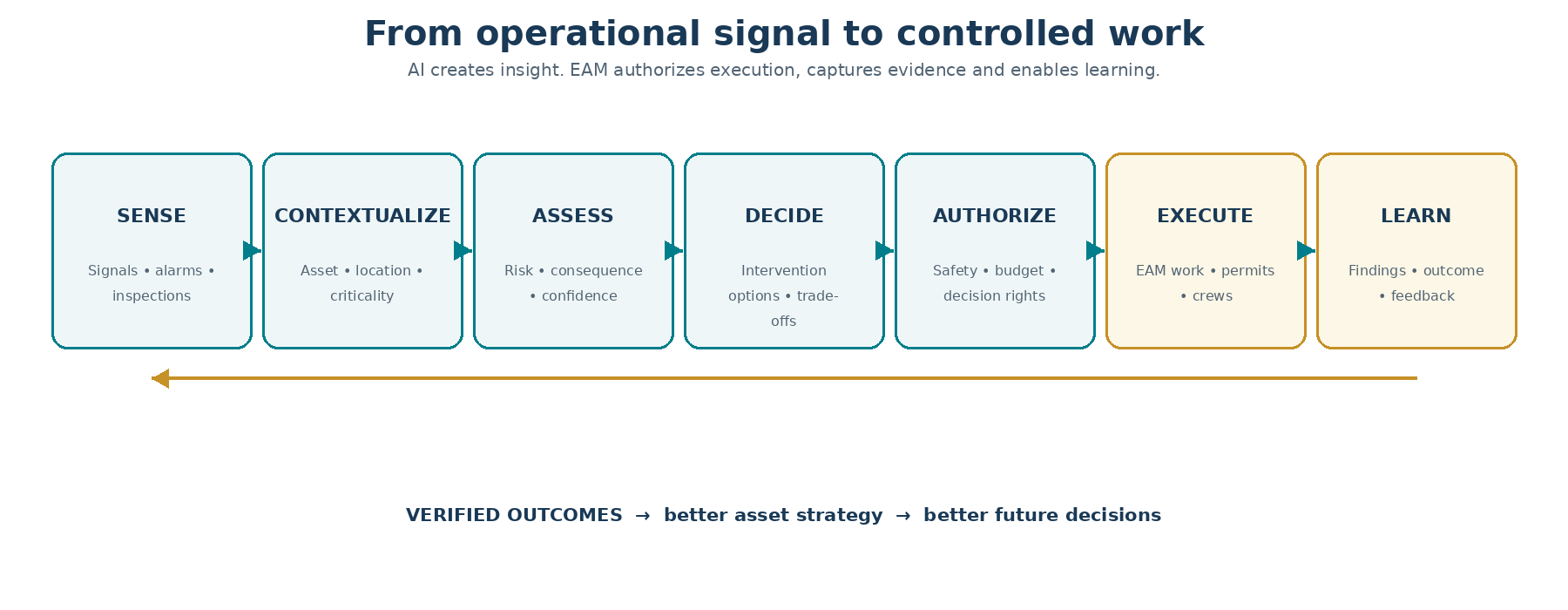 Figure 1. Closed decision loop from operational signals to authorized EAM work and learning.
The key control point is the transition from a recommendation to authorized work and a verified outcome, not the model output alone.
A Practical Example: Transformer Failure Prevention
Consider a transformer showing abnormal deterioration through dissolved-gas, temperature, loading, alarm and inspection data.
- AI identifies the deterioration pattern and estimates failure risk, lead time and confidence.
- The asset record supplies hierarchy, criticality, operating duty, maintenance history, network consequence and spare availability.
- Engineering compares monitoring, inspection, derating, repair and replacement options against safety, outage and cost constraints.
- Approval rules route the recommendation to the accountable engineer and operations owner.
- EAM creates the inspection or maintenance work, reserves parts, assigns skills, links permits and schedules the intervention.
- Field findings and post-work condition are captured to update asset strategy, model performance and the value case.
This is the difference between an analytics output and an operational capability. The prediction becomes useful because the organization can explain it, act on it and learn from the result.
Maturity Is Decision-Specific
Organizations should avoid assigning one AI maturity label to the entire enterprise. A utility may be predictive in maintenance, orchestrated in field service and operating with bounded autonomy in a stable process-control loop. The unit of transformation is the individual decision and the workflow around it.
- Connected — priority data is accessible and contextualized. Decisions remain manual.
- Predictive — models forecast risk and opportunity. People validate recommendations.
- Orchestrated — recommendations trigger coordinated workflows. People approve exceptions.
- Collaborative — role-based copilots support complex work under policy-based oversight.
- Bounded autonomy — systems execute defined decisions within engineered limits, monitoring and fallback controls.
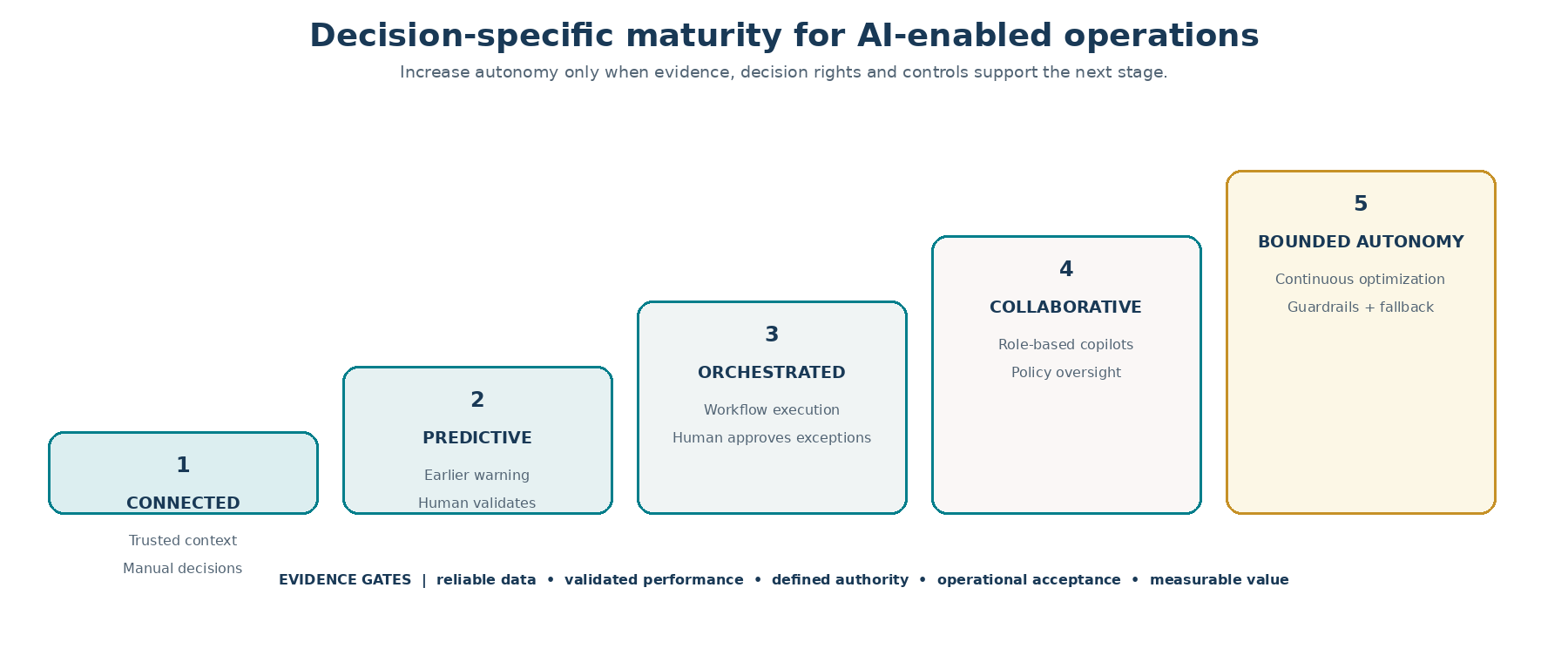 Figure 2. Decision-specific maturity from connected operations to bounded autonomy.
A decision should move to a higher autonomy class only when reliable data, model performance, decision rights, fallback paths, operational acceptance and measurable benefits are demonstrated.
Human Accountability Must Remain Visible
Generative AI can make operational knowledge easier to access and apply. The strongest use cases are role-specific, grounded in approved enterprise content and integrated with the task being performed.
- Operators can summarize events, retrieve procedures and understand recommendations without allowing unapproved control actions.
- Maintenance planners can draft job plans and identify parts, but must validate the asset and safety context.
- Reliability engineers can compare patterns and investigate causes using traceable evidence.
- Field technicians can receive mobile guidance and structure observations while retaining responsibility for final records.
- Executives can translate operating performance into value and risk using governed KPI definitions.
Adoption should be measured through decision quality, cycle time, rework and operational outcomes, not simply by counting chatbot interactions.
Govern Autonomy in Proportion to Consequence
A recommendation for document classification does not need the same assurance as an operating adjustment on critical equipment. Governance should therefore be proportionate to the consequence of the decision.
- Advisory: AI provides insight; a person decides and acts.
- Approval-based: AI prepares an action; an authorized role approves execution.
- Exception-based: AI executes routine actions and escalates defined exceptions.
- Bounded closed-loop: AI acts continuously within engineered limits, monitoring and fallback controls.
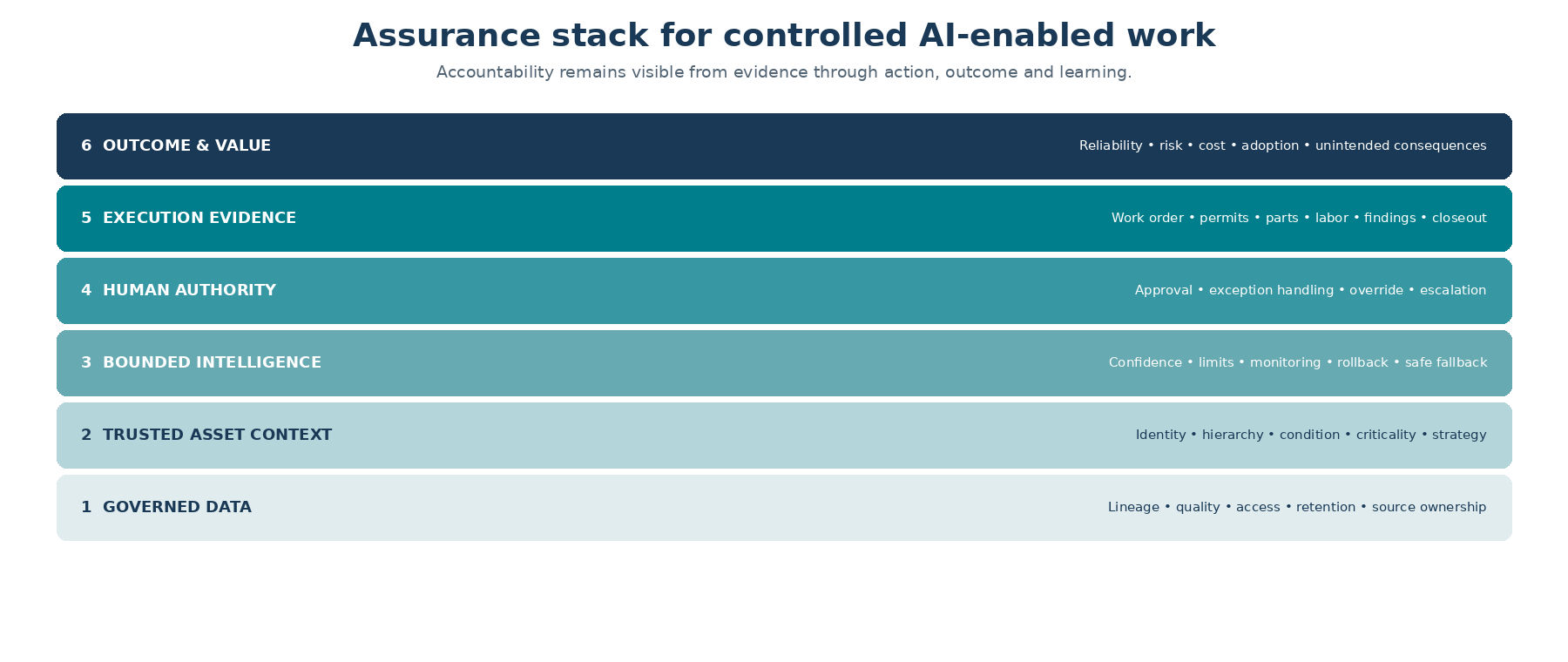 Figure 3. Assurance stack for accountable AI-enabled asset decisions and work execution.
A decision should be automated only when the organization can explain, constrain, monitor and reverse the action.
Start with a Bounded Pilot
A good pilot is not selected because data is available or a model is interesting. It is selected because the decision is valuable, observable and operationally controllable.
A strong pilot should have:
- A high-value asset or decision with a measurable baseline
- Known failure modes or opportunity patterns
- Usable history and trusted asset context
- An operations team ready to act on recommendations
- A defined approval, escalation and fallback process
- End-to-end integration from alert to work execution
- Clear scale, revise or stop criteria
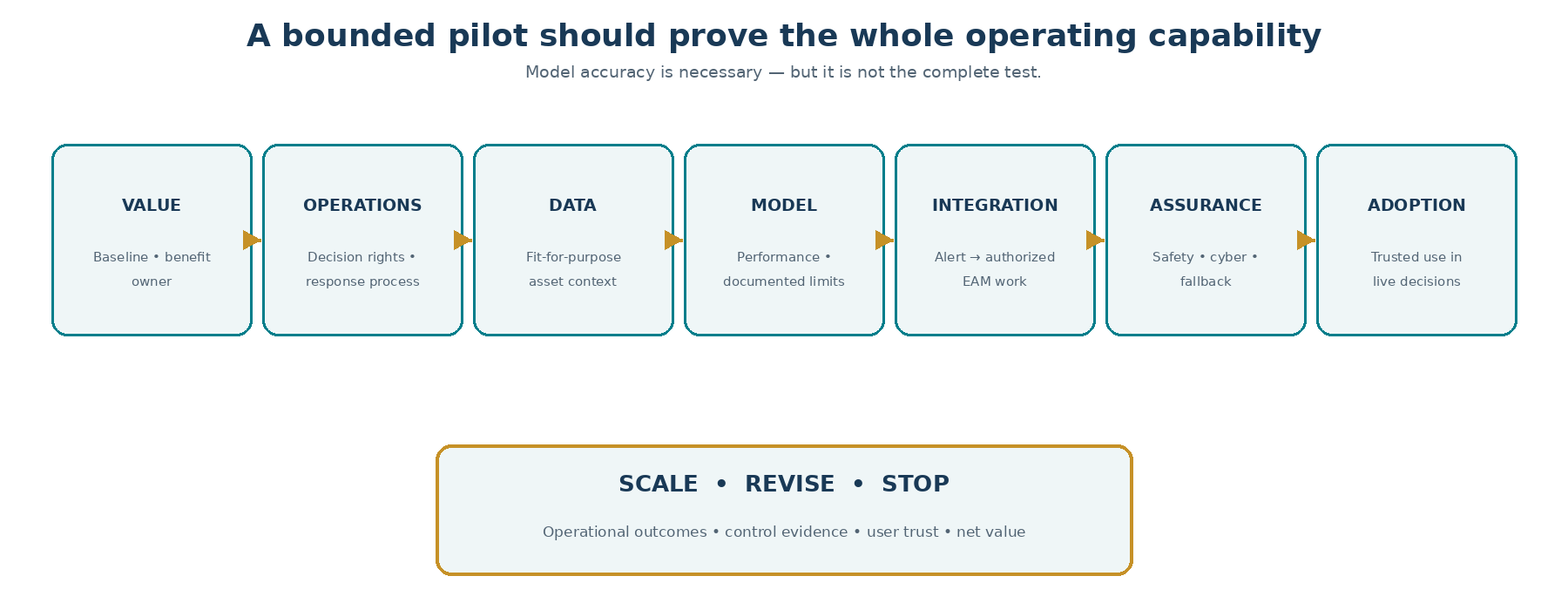 Figure 4. Evidence gates for moving an AI-enabled asset pilot toward scale.
The pilot succeeds when it supports reliable action, earns user trust, preserves operational control and demonstrates business value. Model accuracy is only one part of that test.
Measure Reliability, Risk and Value Together
The value scorecard should connect AI performance with EAM and operational evidence.
- Reliability: availability, repeat failure, defect recurrence, restoration time and avoided failure.
- Maintenance effectiveness: planned-work ratio, schedule compliance, emergency work, rework and planning time.
- Risk: critical defects, overdue inspections, risk exposure and control effectiveness.
- Field execution: first-time fix, closeout quality, safety compliance, travel and material readiness.
- Lifecycle value: asset life extension, whole-life cost, renewal outcomes and post-investment performance.
- AI assurance: acceptance, modification, override, unsupported recommendations, drift and recovery performance.
Benefits should be tracked net of implementation, operating and change costs. Each use case should have a decision owner, workflow owner, baseline KPI and finance-validated benefit hypothesis.
What Commonly Slows Delivery
AI-enabled asset programs often lose momentum because the model is developed faster than the operating foundation.
- Fragmented asset identity across engineering, GIS, SCADA, EAM, APM and finance
- Weak digital handover and incomplete asset, warranty, spare and maintenance records
- Risk decisions based on age without condition and consequence
- Reactive work and poorly controlled backlog
- Disconnected materials, workforce and outage planning
- Inconsistent field capture and failure coding
- OT-IT integration and cybersecurity exposure
- Legacy EAM complexity and local process variants
- Workforce knowledge loss and mistrust of opaque recommendations
- Proofs of concept that do not include workflow integration and lifecycle ownership
Preserve asset context from design through retirement, and preserve human accountability from AI recommendation through operational action.
A Leadership Agenda for the First 90 Days
- Choose two or three decisions where AI can create measurable value.
- Name accountable business, operations and workflow owners.
- Define the current and target autonomy class for each decision.
- Fund reusable asset data, secure integration and governance components.
- Set evidence gates for model performance, operational acceptance, safety, cyber and value.
- Create a visible scorecard and frontline feedback mechanism.
- Define explicit stop criteria for use cases that do not demonstrate value or control.
Closing Perspective
The AI-enabled utility asset enterprise is not defined by the number of models, copilots or dashboards deployed. It is defined by the quality of the decisions the organization can make and execute.
- Trusted asset context should support every recommendation.
- Every recommendation should have an accountable owner.
- Every authorized decision should become executable work.
- Every completed intervention should create evidence.
- Every outcome should improve the next decision.
The real advantage comes from turning trusted intelligence into consistent operational action across the enterprise.
Selected References
- [1] NIST. Artificial Intelligence Risk Management Framework (AI RMF 1.0), January 2023.
- [2] NIST. Cybersecurity Framework 2.0, February 2024.
- [3] ISO. ISO 55000:2024, Asset management — Vocabulary, overview and principles.
- [4] ISO. ISO 55001:2024, Asset management system — Requirements.
- [5] Institute of Asset Management. Asset Management — An Anatomy, Version 4.
- [6] International Energy Agency. Digitalisation and Energy, November 2017.
- [7] C3 AI. Predictive Maintenance for Electric Grid, vendor-reported utility case study.
- [8] ADSP. Predictive Maintenance: Water Pipe Failure Case Study, provider-reported case study.
- [9] NucleusTeq. Preventing Transformer Failures with Predictive Asset Health Intelligence, provider-reported case study.