Modern distribution centers, parcel hubs, and airport baggage operations have become highly automated and highly interdependent. That interdependence is a double-edged sword: it drives efficiency, but it also means a single failed asset—a conveyor, a sorter, a control cabinet—can bring an entire operation to a halt. Product backs up behind the failure point, downstream teams run out of work, and in a 24/7 environment, lost throughput isn't recovered later. It's simply gone.
The core question for reliability and operations leaders isn't whether a failure can be fixed. It's whether it can be seen coming early enough to plan around it. That question is the foundation of the Uptime Preservation Playbook, a framework built around continuous condition monitoring for high-throughput operations.
The P-F Curve: Measuring Your Warning Window
A central concept in the framework is the P-F curve, which is a way to evaluate whether a monitoring strategy gives a team enough time to react. "P" stands for Potential Failure, the earliest point at which degradation becomes detectable. "F" is Functional Failure, the point where the asset can no longer do its job. The interval between the two is the usable window for planning, scheduling, and resolving the issue before it affects operations.
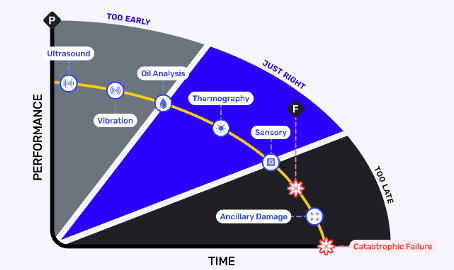
The P-F curve is a practical way to judge whether your maintenance approach gives you enough time to act before asset failure affects operations.
Different detection methods land in different places on this curve. Periodic inspections often catch problems too close to the failure point to be useful. Some early-detection methods can flag issues too far ahead of the point where action is actually needed. Continuous, multi-sensor monitoring is what targets the actionable middle of that window: close enough to failure to justify a repair, early enough to plan it.
Deciding What to Monitor: The Detection-Impact Matrix
Not every asset justifies the cost of continuous monitoring. Using a detection-impact matrix, teams can rank equipment along two dimensions: how much operational impact a failure would cause, and how long the detection gap typically runs for that failure mode. Assets with both high impact and long detection gaps ("Must Monitor") are the top candidates. Lower-impact, easily replaceable equipment may be fine to run to failure. In between are assets worth monitoring as coverage expands.
Across many high-throughput sites, the same categories of equipment tend to surface repeatedly as top priorities: electrical infrastructure, drive systems and variable frequency drives, control cabinets, and critical conveyors or sortation systems. These assets tend to be enclosed, hard to inspect visually, and capable of causing outsized disruption when they fail.
A Phased Rollout Instead of an All-at-Once Deployment
A well-run implementation follows six stages:
- Mapping operational bottlenecks by observing the line in operation
- Identifying single points of failure
- Assessing how those assets are monitored today and estimating their detection windows
- Defining success metrics up front
- Deploying monitoring first on the highest-priority assets
- Expanding coverage based on evidence rather than assumption
The underlying philosophy is this: trying to monitor everything at once is one of the most common reasons these programs stall.
A Comparative Scenario
Consider a single failure mode—a bearing wearing down on a shipping sorter—and how it plays out differently with and without continuous monitoring. Without it, the failure surfaces only once the system trips, triggering a live outage, idle labor, and potential damage to surrounding components. With continuous monitoring, the same degradation is visible while the asset is still functioning, giving the team the option to schedule the repair, stage parts, and avoid unplanned downtime.
Common Pitfalls in Rollouts
Most unsuccessful monitoring deployments fail for organizational reasons, not technical ones. Common pitfalls include:
- Trying to cover every asset at once instead of starting with high-priority equipment
- Failing to define clear workflows for who reviews and acts on alerts
- Not building cross-functional buy-in among operations, engineering, and maintenance teams
- Bringing in IT and security too late in the process
- Underestimating change resistance among technicians
- Launching pilots without predefined success metrics
How This Differs from Predictive Maintenance
One distinction worth understanding: continuous condition monitoring is about detecting real-time degradation using fixed sensors, not forecasting an asset's remaining useful life from historical data. The stated aim is to give teams an actionable early signal, not a long-range prediction. This approach is complementary to, not a replacement for, existing systems like CMMS, SCADA, or BMS platforms—a way to move maintenance teams from reactive to proactive work rather than replacing the people doing it.
Download the full Uptime Preservation Playbook for the complete Detection-Impact matrix, a detailed breakdown of the highest-ROI monitoring zones, and deployment roadmap. Download the Uptime Preservation Playbook