In process industries, such as chemicals, fertilizers and energy plants, effective maintenance management is critical for ensuring equipment reliability, operational continuity, and safety. This article proposes a data-driven framework for the scientific deployment of mechanical maintenance engineers, considering key operational variables, such as plant area, equipment type and criticality, preventive and corrective maintenance workloads, number of outsourced service interventions, purchase requisition (PR) workload, and permit management load.
Drawing from detailed, real-world manpower optimization studies conducted in complex continuous process industries, this framework outlines how engineering resources can be rationalized based on actual workload metrics rather than historical staffing patterns. The framework targets plant directors, human resources officers, and organizational planners seeking to transition from experience-based manpower models to scientific, scalable and performance-driven deployment strategies.
Immediate adoption of such a structured approach promises measurable operational benefits, positioning maintenance organizations for greater agility and resilience in an increasingly competitive industrial environment.
Addressing Industry Challenges
In process industries, the complexity and criticality of plant operations demand a highly reliable maintenance function. Mechanical maintenance engineers form the backbone of this system, ensuring the upkeep of rotary, stationary and utility equipment through preventive and corrective interventions. However, across many industries, manpower deployment strategies for maintenance engineers have historically evolved based on legacy practices, informal estimates, past shutdown experiences, and generalized rules of thumb.
As a result, several common industry-wide challenges have emerged:
- Imbalanced Workload Distribution – Some maintenance engineers are overburdened with operational tasks, vendor coordination, and administrative duties, while others may remain underutilized. This leads to inconsistent performance across units.
- Reactive Maintenance Culture – Inadequate preventive maintenance (PM) due to poor workload balancing results in higher corrective maintenance events, unplanned downtime, and emergency interventions.
- Excessive Reliance on Outsourcing – Without clear manpower planning, critical in-house maintenance tasks increasingly shift to annual rate contract (ARC) vendors, diluting internal technical expertise and increasing dependency risks.
- Permit and Administrative Bottlenecks – Maintenance engineers often spend a significant portion of their workday on permit management, job documentation, and PR processing, reducing effective time available for core technical supervision.
- Overtime and Shift Inefficiencies – Frequent urgent jobs and unplanned breakdowns drive excessive overtime, impacting cost structures and employee well-being.
- Inadequate Adaptation to Equipment Aging and Plant Expansion – Many organizations fail to recalibrate their manpower models as plants either age, requiring more maintenance, or expand, leading to resource misalignment.
Without a scientific, data-backed approach that factors in plant-specific operational realities, organizations risk:
- Increased maintenance costs;
- Reduced asset reliability;
- Poor technician supervision;
- Decreased operational resilience.
A structured, scalable framework addresses these industry challenges, enabling organizations to deploy mechanical maintenance engineers strategically, efficiently and scientifically. This ensures optimum resource utilization and maximum operational impact.
Data Analysis: Foundations for Scientific Manpower Planning
Effective deployment of mechanical maintenance engineers cannot rely solely on organizational intuition or historical norms. A data-driven approach must systematically analyze key operational parameters to match manpower allocation with the actual needs of the plant.
The following critical data points form the foundation for accurate manpower estimation.
1. Plant Area Coverage
- The physical spread of the plant directly impacts the need for engineering supervision.
- Larger, more distributed areas require additional engineers for a timely response to breakdowns, routine inspections, and PM activities.
2. Equipment Inventory and Criticality
- The number, type and criticality of equipment (e.g., rotary, stationary, utility) define the maintenance workload.
- Highly critical equipment (e.g., compressors, turbines, reactors and large pumps) demand closer monitoring, detailed PM, and rapid breakdown response.
3. PM Workload
- Scheduled PM activities, derived from original equipment manufacturer (OEM) manuals and statutory compliance norms, add a fixed baseline workload for maintenance engineers.
- High PM frequency plants (e.g., high-speed rotating equipment) require proportionally higher engineering supervision.
4. Corrective Maintenance (Breakdowns) and Emergency Jobs
- Analysis of Enterprise Resource Planning (ERP) notification data and logbooks helps quantify the historical trend of unplanned corrective maintenance.
- Plants with frequent emergency jobs (e.g., shutdowns, equipment failures) require engineers readily available to respond.
5. Permit Management Load
- Engineers must handle both ERP and manual permit to work systems, often spending considerable time doing job documentation, coordination, and safety compliance.
- The higher the number of work permits processed, the greater the administrative load on each engineer.
6. PR and Indent (internal order requisition) Activity
- Engineers are responsible for technical evaluations, purchase requisition preparation, and material follow-up for maintenance jobs.
- Plants with a high volume of procurement activity need more engineering bandwidth for efficient job execution.
7. Outsourced Services Supervision (ARC Workload)
- The extent of ARC and other outsourced maintenance work significantly affects engineer deployment.
- Each outsourced service (e.g., hydro jetting, piping jobs, scaffolding, etc.) requires technical supervision, quality checks, and permit management by internal engineers.
8. Overtime and Shift Data
- Overtime records reflect workload peaks and resource shortages.
- Frequent overtime trends point toward the need for recalibrating manpower distribution to maintain sustainable work patterns.
Working Methodology: Time-Based Estimation for Mechanical Maintenance Engineer Deployment
Accurate deployment of mechanical maintenance engineers must be rooted in an analysis of supervisory workload, activity volumes, and time requirements, not technician counts or traditional norms. This methodology is based on real-world field observations and detailed time study analysis conducted in a large-scale ammonia process plant.
Step 1: Identify and Categorize Maintenance Activities
Engineer activities were grouped into major functional categories:
- PM supervision;
- Corrective maintenance (breakdown) supervision;
- ARC vendor job supervision (outsourced work);
- Permit preparation and closure (ERP and manual systems);
- Purchase requisition / indent processing.
Each category was evaluated for workload intensity and time consumption.
Step 2: Establish Time Standards Based on Field Observations
Field studies and interviews with maintenance personnel led to the average time estimates shown in Table 1.
 Table 1 – Time Estimation Basis for Maintenance Activities
Step 3: Collect and Quantify Plant Workload Data
Typical monthly workload data was gathered from a process industry and generalized for confidentiality.

Step 4: Calculate Total Man-Hours Required
Multiplying activity volume by average time yields the total monthly man-hours, as shown in Table 2.
 Table 2 – Monthly Workload Estimation
Step 5: Determine Engineer Working Capacity
The calculation considers standard working hours, leaves, meetings and administrative downtime.
- Effective available hours per engineer per month≈ 150 hours.
Step 6: Final Man-Power Calculation

The calculation adds a 10 percent contingency buffer to account for unexpected urgent breakdowns, shutdowns and leaves.
- Final Recommended Deployment: Four to Five mechanical maintenance engineers
Insights: Trends and Observations From Maintenance Manpower Optimization
Through detailed manpower optimization studies in continuous process industries, like ammonia, urea and utility plants, several clear trends and insights have emerged regarding mechanical maintenance engineer deployment:
Traditional Deployment Models Are Outdated – Most organizations still rely on historical norms or rough estimates (e.g., one engineer for every X technician or one engineer per area) rather than scientific workload assessments.
These outdated methods lead to:
- Overstaffing in low-activity zones;
- Understaffing in critical production units;
- Higher costs without proportional gains in reliability.
Engineers’ True Role Is Supervision, Not Physical Work Execution – Mechanical engineers are primarily responsible for:
- Supervising preventive and corrective maintenance;
- Managing permits and compliance documentation;
- Coordinating outsourced vendors (ARC jobs);
- Preparing technical specifications for procurement (PRs).
They do not physically repair equipment; this is performed by technicians and contractors. Supervisory load, not technician count, should drive engineer deployment planning.
Permit Management and Documentation Load Is Significant – Across most plants, permit to work systems, both ERP-based and manual, consume 15 to 20 percent of an engineer’s monthly effective working time. Without factoring administrative load into manpower planning, engineer deployment is systematically underestimated.
Outsourced Services Add Hidden Supervision Load – ARC services, such as piping jobs, hydro jetting, radiography and insulation, require significant time from internal engineers for site supervision, safety permit approvals, quality checks, and final job closure. Ignoring ARC supervision load leads to invisible workload accumulation on in-house engineers.
Preventive Maintenance (PM) Is Undervalued in Planning – Organizations often underallocate engineers to preventive maintenance planning and supervision, leading to degraded equipment health, higher corrective maintenance load, and increased plant downtime.
A strong preventive maintenance program supervised by adequately deployed engineers significantly reduces overall maintenance costs.
Overtime and Emergency Response Pressures Reflect Poor Planning – Frequent overtime (OT) trends and rushed shutdown maintenance jobs indicate underlying manpower imbalances. Scientific planning based on time-motion analysis provides stable shift patterns, reduced emergency overtime, and healthier work environments.
Digitalization Is Underutilized – Although many organizations have adopted ERP plant maintenance (PM) modules or equivalent digital systems, they are often used mainly for recordkeeping and not for manpower workload analysis. There is a strong opportunity to integrate digital permit systems, mobile inspections, and real-time workload dashboards for smarter manpower planning.
Proposed Framework: Scientific Deployment of Mechanical Maintenance Engineers
Building on field study insights, time-study models, and operational data analysis, the following structured framework is proposed for scientific manpower planning of mechanical maintenance engineers in process industries.
Step 1: Data Collection and Workload Mapping
- Identify Key Work Categories: Preventive maintenance, corrective maintenance, ARC vendor supervision, permit management, purchase requisition / indent work, and any other work
- Collect Activity Volumes: Number of PM jobs per month; average breakdowns per month; number of ARC jobs; permit volume (ERP and manual); purchase requisition and indent volumes.
- Gather Equipment Details: Total number of rotary and stationary assets, complexity and criticality.
Step 2: Establish Time Standards
- Define average time per activity based on field studies, work studies, or standard times.
- Recommended starting points based on field study: PM Job: 1.5–2.0 hours; Breakdown Job: 2.5–3.0 hours; ARC Supervision Job: 2.0–2.5 hours; Permit Management: 30–45 minutes per permit; Purchase Requisition / Indent Processing: 2.0–2.5 hours per PR
Step 3: Calculate Total Workload (Man-Hours)
- Multiply the monthly volume of each activity by the average time per activity.
- Sum the man-hours across all activities to get the total monthly workload.

Step 4: Define Effective Working Hours per Engineer
Establish realistic available hours after adjusting for weekly off days; national and/or plant holidays; training, meetings and administrative overhead; and shift handovers.
- Typically, assume ~120–130 effective hours/month per engineer.
Step 5: Calculate Engineer Requirement

- Add a 10 to 15 percent contingency buffer to cover absenteeism, urgent shutdowns, and unexpected emergency jobs.
Step 6: Validate Against Plant Complexity
- Plants with higher criticality equipment (e.g., high-pressure boilers, reactors, ammonia converters) may require slight upward adjustments (five to 10 percent more manpower).
- Plants with highly reliable, modern equipment may allow for slight downward adjustments.
Step 7: Monitor and Adjust Regularly
- Revalidate manpower needs every two to three years.
- Update workload data, ARC dependency levels, plant expansions, and equipment aging factors.
- Integrate ERP PM or digital maintenance systems for live manpower analytics dashboards.
Business Benefits of Scientific Deployment of Maintenance Engineers
Adopting a data-driven, supervision-based framework for mechanical maintenance engineer deployment offers significant benefits at multiple levels.
Operational Benefits
- Enhanced Plant Reliability – Better supervision of preventive and corrective maintenance leads to higher asset uptime and reduced unplanned shutdowns.
- Improved Work Quality – Structured supervision ensures vendor performance, technician efficiency, and adherence to maintenance standards.
- Faster Response to Emergencies – Optimized manpower distribution ensures critical breakdowns are addressed swiftly without overloading specific teams.
Financial Benefits
- Cost Optimization – Avoids unnecessary overstaffing while ensuring no critical function is left unsupervised, leading to a lean, efficient organization.
- Reduced Overtime and Contractual Penalties – Balanced manpower minimizes emergency overtime hours and enhances compliance with maintenance schedules, avoiding penalties for production delays.
- Optimized Outsourcing Costs – Better supervision of ARC vendors improves contractor productivity, reducing the need for repeat work or escalations.
Strategic Benefits
- Data-Driven Decision-Making Culture – Shifts maintenance planning from experience-based to evidence-based practices, building a stronger operational foundation.
- Agility During Plant Expansions or Upgrades – Manpower can be dynamically adjusted based on real-time workload analysis, supporting plant changes more flexibly.
- Better Talent Utilization and Development – Engineers focus on higher-value activities (e.g., planning, optimization, reliability improvements) rather than being bogged down by avoidable administrative overload.
Conclusion
In the high-demand environment of process industries, maintenance effectiveness directly determines operational continuity, equipment longevity, and organizational profitability. Mechanical maintenance engineers are pivotal in this ecosystem, not by performing physical repairs themselves, but by planning, supervising, coordinating and ensuring execution quality.
However, traditional manpower deployment models based on legacy norms, technician counts, or fixed area coverage assumptions are increasingly inadequate in a modern, dynamic industrial context. They lead to inefficiencies, increased operational risks, and hidden financial burdens.
Through a simple, but powerful, working methodology — gathering operational data, applying time standards, and dynamically matching supervision load to engineer capacity — companies can scientifically define the optimal number of maintenance engineers required for sustainable, resilient operations.
Adopting this model positions organizations not just for immediate operational excellence, but for long-term strategic competitiveness in an industry landscape increasingly defined by data-driven decision-making, digital integration, and lean productivity principles.






 Table 1 – Time Estimation Basis for Maintenance Activities
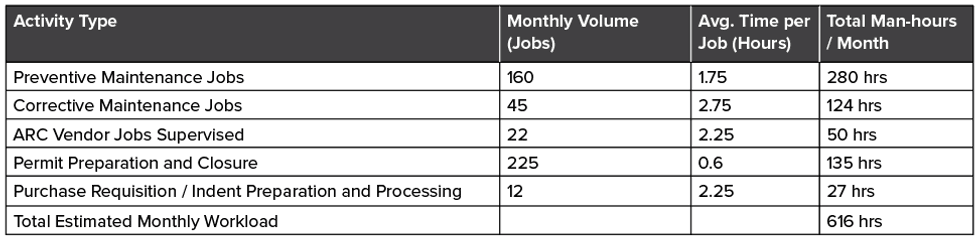 Table 2 – Monthly Workload Estimation